
Mietmakler
Mietmakler – The world of property rental can be complex for both landlords and tenants. In this environment, Mietmakler (also known as rental agents, apartment brokers, or commission-based agents) operate as specialized service providers who offer a professional framework for successfully initiating tenancies. This comprehensive guide explains what a rental agent is, what services they provide for landlords and tenants, how costs are regulated, and what to look for when choosing one.
What is a Mietmakler? Definition and Legal Role
A Mietmakler is a real estate professional who, on behalf of one party—either the landlord (landlord’s agent) or the tenant (tenant’s agent—undertakes the mediation of a lease agreement for an apartment, house, or commercial space. Their core task is to find the right contractual partner and prepare the conclusion of the lease. Legally, this is a commercial broker acting under the provisions of the German Civil Code (BGB, §§ 652 ff.). The broker’s contract is a service contract that can generally be concluded informally, though written form is highly recommended for clarity.
Services of a Rental Agent for the Landlord (Letting Agent)
For private and commercial landlords, the rental agent takes on a large part of the effort associated with renting out a property.
Professional Market Analysis and Price Determination
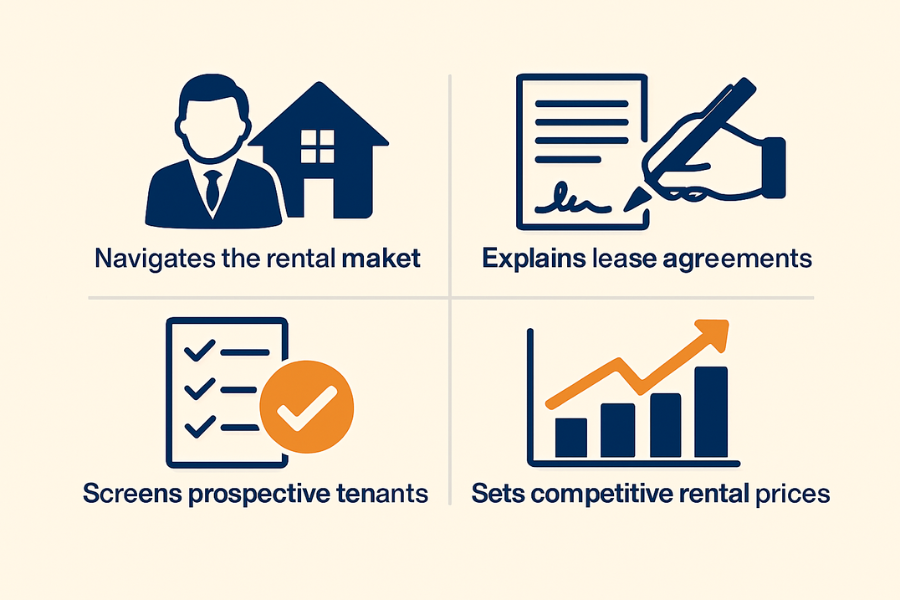
The agent determines a realistic and legally sound rental price (net cold rent) based on location, features, current market conditions, and comparable rents. This prevents both undervaluation of the property and inflated price expectations that can lead to long vacancies.
Marketing and Creation of a Meaningful Exposé
One of the main tasks is the professional presentation of the property. This includes:
- Creating an appealing, detailed exposé with high-quality photos, floor plans, and compelling descriptions.
- Placing advertisements on all relevant real estate portals (Immoscout24, Immowelt, etc.).
- Targeted approach to potential tenants through their own network and databases.
Organization and Conduct of Viewing Appointments
The agent coordinates all viewings, guides interested parties through the properties, and answers expert questions on-site. This saves the landlord a tremendous amount of time and organizes the viewing process efficiently.
Pre-selection and Credit Check of Interested Parties
Before presenting candidates to the landlord, the rental agent conducts an initial qualification of interested parties. This includes:
- Reviewing and checking self-disclosure forms (tenant self-disclosure).
- Obtaining Schufa credit reports or other credit information (with the consent of the interested party).
- Verifying pay slips and employment contracts for authenticity and adequacy of income.
Negotiation and Contract Preparation
The agent assists in the final selection of the tenant, negotiates the rent and contract conditions, and prepares the lease agreement using standard forms or in consultation with the landlord.
Services of a Rental Agent for the Tenant (Tenant’s Agent)
For tenants as well, especially in tight housing markets in major cities, commissioning an agent can be useful.
Individual Needs Analysis and Search for Suitable Properties
The agent clarifies the exact requirements (location, size, budget, features) in a preliminary discussion and actively searches for suitable offers, which are often not publicly advertised (silent listings).
Access to Exclusive Offers and Early Information
Many agents have access to properties before they are listed online. Tenants thus gain a crucial competitive time advantage for viewings and applications.
Organization of Viewings and Expert Advice
The agent relieves the tenant of the time-consuming search and appointment coordination and accompanies viewings with a professional eye for quality and potential defects.
Support with the Application and Negotiation
An agent helps create a compelling rental application with all necessary documents. They can also assist in negotiating the rent or special conditions in the lease.
The Costs: Who Pays the Broker’s Commission (Courtage)?
The question of who bears the cost is clearly regulated by law and is a central topic. The “Bestellerprinzip” (Principal Principle), in effect since June 2015, states: Whoever commissions the broker also bears the costs.
- If the landlord commissions the agent, the landlord must pay the commission. The tenant incurs no costs for the agent’s services.
- If the tenant commissions an agent for the search, the tenant must pay the agreed commission to their agent.
The amount of the commission is negotiable and is stipulated in the broker’s contract. A commission of 1.5 to 3.0 net cold monthly rents (plus statutory VAT) is customary. The commission becomes due upon conclusion of the lease and is typically payable immediately.
Important Note: Always ensure you have a written brokerage agreement that clearly defines the client, the amount of the commission, and the conditions for its due date. An agent may only demand a commission if they can prove they have brought about the success (the conclusion of the lease) (§ 652 BGB).
How to Choose a Reputable Rental Agent?
Choosing the right partner is crucial for a smooth process.
- Expertise and Specialization: Look for an agent with solid training (e.g., as a “Geprüfter Immobilienfachwirt” IHK) and local market knowledge in your target region.
- Transparency and Communication: A reputable agent explains all steps, costs, and contract clauses understandably and without pressure.
- Written Agreement: Take your time to read the brokerage contract before signing. Pay attention to clauses regarding exclusive mandate, commission, and termination periods.
- Reputation and References: Check online reviews, ask for references, and look for a professional appearance.
Advantages and Disadvantages of Working with a Rental Agent
Advantages for Landlords:
- Saves time and labor
- Professional marketing and pricing
- Pre-selection of qualified tenants, lower risk of rental payment defaults
- Knowledge of legal frameworks
Disadvantages for Landlords:
- Cost of the agent’s commission
- Relinquishing some control over the process
Advantages for Tenants (when commissioning their own agent):
- Saves time and reduces search stress
- Access to exclusive listings
- Professional support with application and negotiation
Disadvantages for Tenants (when commissioning their own agent):
- Additional cost for the commission
Alternatives to a Rental Agent
- Renting/Searching Independently: Through online portals, local ads, and word-of-mouth. Saves costs but requires significant time and know-how.
- Property Management Company: Many property management companies also handle the rental of vacant units within a portfolio.
- Housing Cooperatives and Institutional Landlords: These often rent their properties through internal departments without external agents.
Questions & Answers (FAQ)
Q1: What exactly is the difference between a Mietmakler and an Immobilienmakler?
A1: An Immobilienmakler is the umbrella term for agents dealing with land and buildings. A Mietmakler is a specialized real estate agent who focuses exclusively on mediating rental relationships, not on the purchase and sale of property.
Q2: As a tenant, do I always have to pay the agent if I get an apartment?
A2: No. Since the introduction of the Principal Principle, only the party who commissioned the agent pays the commission. If you find an apartment through an agent commissioned by the landlord, you as the tenant are exempt from the agent’s fees.
Q3: How high is the commission for a rental agent typically?
A3: The courtage is typically between 1.5 and 3.0 net cold monthly rents plus 19% VAT. The exact amount is negotiable and must be stipulated in the brokerage contract.
Q4: What is an “exclusive mandate” with a rental agent?
A4: An exclusive mandate (or sole agency agreement) authorizes only this one agent to market the property for a specific period. If the landlord concludes the lease during this period even without the agent’s involvement, a commission may still be due. Pay attention to the contract duration.
Q5: Can an agent demand a commission from both sides (landlord and tenant)?
A5: In principle, an agent can enter into separate contracts with both parties (double commission). However, this must be communicated transparently to all involved and agreed upon in the respective contracts. It is a less common model.
Q6: What documents should I as a tenant prepare for the first meeting with an agent?
A6: Prepare: tenant self-disclosure form, current proof of income (last 3 months), Schufa credit report, copy of your ID card/passport, and possibly rent payment confirmations from your current landlord.
Q7: What does a rental agent do during the credit check?
A7: The agent checks the creditworthiness of a rental applicant, primarily by obtaining a Schufa report. This provides information about existing credit obligations and negative entries (e.g., open claims). Additionally, proof of income is reviewed to ensure the tenant’s ability to pay the rent.
Q8: Is an oral brokerage agreement legally binding?
A8: Yes, a brokerage agreement is valid without a specific form. A written contract is strongly recommended as it provides proof of the agreed commission, services, and due date, preventing misunderstandings.
Q9: When exactly does the agent’s commission become due?
A9: The commission becomes due as soon as the lease agreement is effectively concluded (typically upon signing by both parties). This is independent of the actual move-in date. The payment deadline should be stated in the contract.
Q10: Can I commission a rental agent only for viewings?
A10: That is unusual. A brokerage agreement typically refers to the successful mediation (conclusion of the lease). A pure advisory or viewing service without a mediation mandate would have to be agreed upon separately as a service based on an hourly rate.
Conclusion: The Rental Agent as a Valuable Partner in the Real Estate Process
The decision for or against a rental agent depends heavily on the individual situation, available budget, and one’s own expertise. For landlords who want to save time, desire professional marketing, and minimize the risk of a problematic tenancy, a good agent is a worthwhile investment. For tenants in tight markets, commissioning their own agent can provide the decisive advantage in the search for their dream apartment.
The key to successful cooperation lies in clear communication, a transparent written contract, and the choice of a reputable, knowledgeable partner. A competent rental agent not only provides organizational relief but also creates legal certainty and ensures a smooth process—from the first exposé to the handover of the keys.