Golf Stroke Tips: Why Your Golf Stroke is the Heart of Your Game
Every golfer, from weekend warriors to tour professionals, shares a single, universal goal: to strike the ball consistently well. The golf stroke—that complex, coordinated motion from backswing to follow-through—is the fundamental engine of your game. A powerful, efficient stroke translates directly to longer drives, more accurate approach shots, and lower scores. Yet, for many, it remains a source of frustration. This comprehensive guide breaks down the golf stroke into its core components, offering actionable, step-by-step tips grounded in proven swing mechanics. We’ll move beyond quick fixes to build a deeper understanding of how and why a good swing works, empowering you to make lasting improvements.
Part 1: The Non-Negotiable Foundation – Setup and Grip
You cannot build a reliable skyscraper on a shaky foundation, and the same is true for your golf swing. Over 80% of swing flaws originate from a poor setup or grip. Before you even think about taking the club back, master these fundamentals.
The Athletic Stance: Your Platform for Power
Your posture and alignment create the framework for your entire motion.
- Stance Width: For a driver, your feet should be roughly shoulder-width apart. As clubs get shorter, your stance should narrow slightly. This promotes stability for the long levers and more precision for the short irons.
- Posture: From a standing position, push your hips back as if sitting in a high barstool, allowing your spine to tilt forward from the hips. Your back should be straight, not rounded or arched. Let your arms hang freely down. This “athletic posture” is seen in almost every sport—ready for action.
- Weight Distribution: For full swings, start with your weight balanced 50/50 on the balls of your feet—not on your heels or toes. For an iron, you might feel a slight favor towards your front side (55/45).
- Ball Position: A universal constant is that the ball position relative to your body changes with each club. For a driver, play the ball off the inside of your front heel. For a mid-iron, center it in your stance. For a wedge, it should be just behind center.
The Grip: Your Only Connection to the Club
The grip is the steering wheel and throttle for your swing. A faulty grip forces your body into compensatory, inconsistent motions.
- “Neutral” is Key: The goal is a neutral grip, where the “V”s formed by your thumb and forefinger on both hands point between your chin and right shoulder (for right-handed golfers).
- Pressure Matters: Hold the club firmly enough to control it, but lightly enough that your forearms and hands don’t tense. A common analogy is to hold a tube of toothpaste without squeezing any out—a “5 out of 10” pressure level.
- Hand Unity: Your hands should work as a single unit. Whether you use an interlock, overlap, or baseball grip, ensure there is no gap between the hands, and the lifeline of your trail hand (right hand for righties) rests snugly over the lead thumb.
Part 2: The Swing Sequence – A Kinetic Chain in Motion
The modern golf swing is a masterpiece of kinetic energy transfer, from the ground up through the body and into the clubhead. Understanding this sequence is critical.
The Takeaway and Backswing: Loading the Spring
The first move away from the ball sets your swing plane and stores energy.
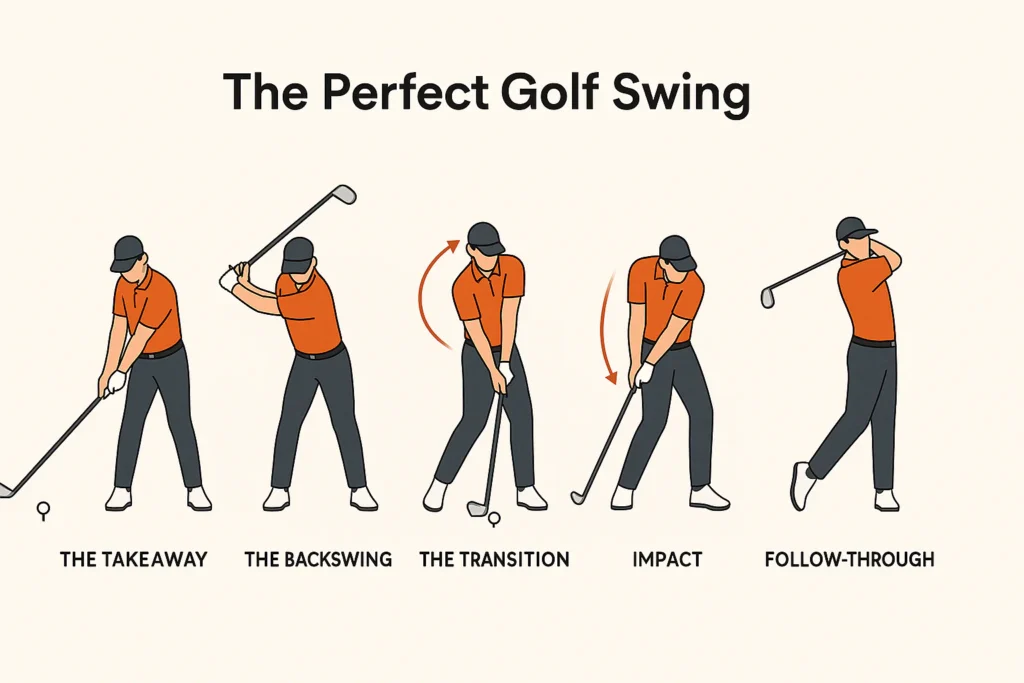
- One-Piece Takeaway: Initiate the swing by turning your shoulders, chest, and arms away from the target as a single, connected unit. Avoid an early wrist hinge or picking the club up with your hands.
- Full Shoulder Turn: A full backswing is defined by shoulder rotation, not arm lift. Strive for a 90-degree shoulder turn while your hips resist, turning only about 45 degrees. This creates a powerful “coil” or “X-factor” stretch between your upper and lower body—your primary source of power.
- Top Position: At the top, your lead arm should be relatively straight (not rigid), the club should be parallel to your target line, and your weight should be loaded into your back leg.
The Downswing: Unleashing Stored Energy
This is the moment of truth. The correct sequence is non-negotiable for speed and consistency.
- Initiate from the Ground: The downswing begins with a subtle lateral shift of your lower body toward the target, followed immediately by a powerful rotation of your hips. Your arms and hands should feel like they are dropping passively as a reaction to this lower body movement. The common amateurs’ mistake is starting the downswing with the shoulders or arms (“casting”), which loses all stored power.
- The “Lag” Position: As your hips fire, the angle between your lead arm and the club shaft should be maintained as long as possible. This “lag” is the secret to clubhead speed. Imagine cracking a whip—the handle moves first, and the tip accelerates last.
Impact and Follow-Through: The Result and Finish
Impact is not something you aim for; it’s the inevitable result of a good sequence.
- Impact Position: Your body should be ahead of the ball, with your hands leading the clubhead. Your hips are open (facing left of target for righties), while your shoulders are still slightly closed. The clubface must be square to the target line. This is the only millisecond that truly matters.
- Full, Balanced Finish: A good swing ends in a full, balanced finish. Your chest faces the target, your weight is fully on your front foot, and your back foot is up on its toe. The club should finish comfortably behind your neck. If you can’t hold your finish for three seconds, your swing was off-balance.
Part 3: Conquering Common Faults – Diagnosis and Cures
Let’s apply this knowledge to fix the most pervasive issues.
| Common Fault | Likely Cause(s) | Simple Drill for Correction |
|---|---|---|
| The Slice (Ball curves right) | Out-to-in swing path with an open clubface. Often caused by an over-the-top downswing. | Headcover Drill: Place a headcover just outside the ball (target side). Practice hitting balls without touching the headcover, encouraging an in-to-out path. |
| The Hook (Ball curves left) | In-to-out swing path with a closed clubface. Often from an overly active lower body or strong grip. | Toe-Up Drill: On the takeaway, when the club is parallel to the ground, check that the toe of the club is pointing straight up. This promotes a neutral clubface. |
| Topping or Chunking the Ball | Major loss of spine angle during the swing; moving up and down instead of rotating around a stable axis. | Head Against Wall Drill: Setup with the right side of your head touching a wall. Make slow practice swings, keeping your head in contact with the wall throughout. |
| Lack of Distance | Poor kinetic sequence, loss of lag, or failing to use the ground for power. | Step Drill: Start with 80% of your weight on your back foot. Start your downswing by aggressively stepping into your front foot as you swing. |
Part 4: Beyond the Full Swing – Short Game and Practice Philosophy
A great long game gets you on the green; a great short game gets you in the hole.
The Putting Stroke: A Pendulum in Motion
Putting is a separate, refined skill. Use your shoulders to rock your arms, chest, and putter back and through as a single unit. Wrist action should be minimized. Focus on consistent tempo and solid contact on the sweet spot. Practice distance control by putting to the fringe without a ball, listening for a consistent rhythm.
Deliberate, Smart Practice
Hitting 100 mindless drivers on the range ingrains bad habits. Practice with purpose:
- Use Alignment Sticks: These are the cheapest and most effective training aids. Use one for your feet line and one for your ball-target line.
- 80/20 Rule: Spend 80% of your practice time on shots from 100 yards and in (wedges, chipping, putting).
- Create a Pre-Shot Routine: Develop a consistent routine (e.g., stand behind ball, pick intermediate target, waggle, swing) to trigger focus and replicate on-course pressure.
Frequently Asked Questions (FAQ)
1. What is the single most important tip for a beginner?
Master the setup and grip first. Everything else builds from this foundation. A good setup makes a good swing easier to achieve.
2. How do I stop slicing the ball?
Focus on initiating the downswing with your lower body, not your shoulders. The “headcover drill” (above) is excellent for training the correct inside path.
3. Should I keep my head down during the swing?
This is a misunderstood adage. The goal is to maintain your spine angle, not freeze your head. Your head will naturally rotate slightly in the backswing and up through impact. Forcing it “down” often restricts rotation.
4. How can I get more distance?
Power comes from sequence, not strength. Ensure you are fully coiling your upper body against a stable lower body in the backswing, then starting the downswing with a powerful hip rotation, preserving lag.
5. What does “swing easy” really mean?
It refers to tempo and tension. A smooth, rhythmic swing at 80% of your max effort will often produce more clubhead speed than a tense, jerky, 100% effort swing because it allows for proper sequencing.
6. How often should I practice?
Consistency trumps volume. Practicing for 30 minutes, 3 times a week with focused drills is far more beneficial than a single 4-hour marathon session once a month.
7. Are expensive lessons worth it?
A single lesson with a qualified PGA Professional to diagnose your fundamental flaws (grip, posture, alignment) is one of the best investments you can make. They provide an objective eye you cannot have for yourself.
8. What’s the best drill for improving contact?
The “divot after the ball” drill. Place a tee in the ground just in front of your ball. Focus on hitting the ball first and then the tee, creating a divot that starts after the ball’s position.
9. How do I know if my clubs fit me?
Poorly fit clubs can force compensations. If you are consistently very tall, short, or have unusual posture, a basic club fitting is advisable. Signs of ill-fit include constant toe or heel strikes and chronic posture issues at address.
10. What role does fitness play in a better golf stroke?
A significant one. Golf-specific fitness focusing on core strength, hip and thoracic spine mobility, and rotational power can dramatically improve your stability, range of motion, and speed.
11. Why do I hit it well on the range but poorly on the course?
This is often a mental shift. On the range, there are no consequences. On the course, pressure activates a “hit” instinct, disrupting your smooth tempo. Develop a trustable pre-shot routine and practice with consequences (e.g., “I must hit 5 fairways in a row before I leave”).
12. Should I use a strong, weak, or neutral grip?
95% of amateur golfers should start with and master a neutral grip. Strong and weak grips are advanced adjustments to correct specific ball flight issues.
Conclusion: The Journey to a Better Golf Stroke
Improving your golf stroke is a journey of mindful practice and incremental understanding. There is no magic bullet, but there is a clear path: build a faultless foundation, understand the kinetic sequence of a powerful swing, diagnose your specific faults with targeted drills, and dedicate time to the scoring shots. Progress is measured not just in added yards, but in more consistent contact, predictable ball flight, and the confidence that comes from knowing why the ball did what it did.
Commit to being a student of the game. Film your swing occasionally, invest in foundational knowledge, and practice with purpose. Remember, even the world’s best players are constantly refining their strokes. Embrace the process, and you will undoubtedly see your scores—and your enjoyment of this magnificent game—rise. Now, take these tips, head to the range with a plan, and start building your best swing.