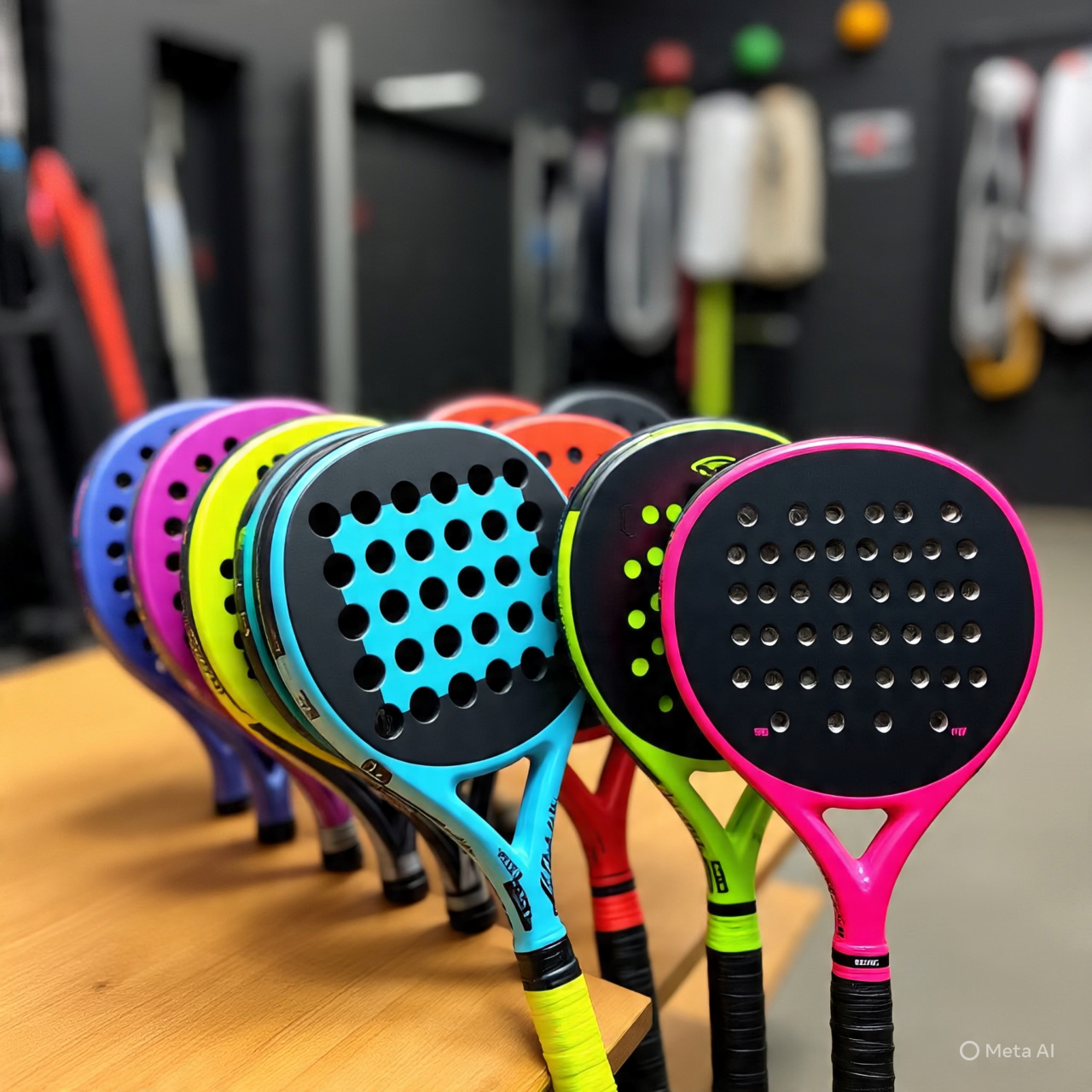
Padel Racket
Padel Racket – The sport of padel has witnessed a meteoric rise in global participation, transitioning from a social activity to a professionalized discipline requiring highly specialized equipment. As the market matures, the technical sophistication of padel rackets has evolved to meet the diverse needs of players across all skill levels. This article provides an exhaustive analysis of the architectural, material, and geometric properties of padel rackets, focusing on the innovations defining the 2025 and 2026 seasons.
https://newstimesports.com/master-the-court/You Might Also Like: Pickleball Serving Rules for Beginners
Historical Evolution and the Physical Nature of the Game
Padel emerged in Acapulco, Mexico, in 1969, conceived by Enrique Corcuera, who sought to adapt a traditional racket sport to a confined space. Initially, players utilized wooden paddles similar to those used in platform tennis. As the sport migrated to Spain and Argentina, the equipment evolved rapidly, moving away from wood toward composites like fiberglass and later, high-performance carbon fiber.
The fundamental design of a padel racket—solid, perforated, and stringless—is dictated by the physics of a 20×10 meter enclosed court. Unlike tennis, where strings generate power through a trampoline effect, padel relies on the compression of a foam core against a composite face to manage power and control within the confines of glass walls and fences. This transition from “brute force” to “strategy and finesse” has defined the technological trajectory of modern professional padel rackets.
Technical Anatomy of the Modern Padel Racket
The performance of a high-performance padel racket is determined by the synergy between its three primary structural components: the frame, the core, and the striking surface or face.
The Frame: Structural Stability and Aerodynamics
The frame provides the skeletal integrity of the racket. In modern professional models, frames are almost exclusively made of carbon fiber or carbon-reinforced composites. Carbon fiber is selected for its exceptional rigidity, lightweight properties, and resistance to impact fatigue.
Innovations for the 2025-2026 season have focused on frame geometry to reduce air resistance. Technologies such as the “Air React Channel” or “Dynamic Air Flow” (DAF) optimize airflow around the frame, allowing players to swing faster and react more quickly during rapid net exchanges. A more aerodynamic frame reduces the physical strain on the wrist and forearm, contributing to better long-term performance and injury prevention.
The Core: EVA Foam vs. Polyethylene
The core is the “heart” of the racket, largely determining the feel, rebound, and sound upon impact. Manufacturers primarily use two materials: Ethylene Vinyl Acetate (EVA) and Polyethylene (PE).
| Core Type | Material Properties | Response | Ideal Player |
| Hard EVA | High density, rigid | Direct energy transfer, high power | Advanced / Professional |
| Soft EVA | Lower density, elastic | High rebound, comfort, easy power | Beginner / Intermediate |
| Multi-layered EVA | Variable densities | Adaptive response to hit intensity | Versatile / Advanced |
| Polyethylene | Very soft, high damping | Maximum shock absorption | Injury-prone / Comfort-seekers |
EVA foam is known for its durability and responsiveness. High-density EVA is preferred by advanced players who possess the strength to compress the material and desire precision in their shots. Conversely, softer foams are more forgiving and provide a “spring-like” effect that helps beginners generate depth with less effort. 2026 models frequently feature multi-density cores, such as Babolat’s X-EVA, which uses harder outer layers for power and a softer inner layer for comfort and defensive precision.
The Face: Carbon Weaves and Hybrid Surfaces
The striking surface is where the mechanical energy of the swing meets the ball. Fiberglass faces are common in entry-level and intermediate rackets because the material is more flexible and offers a larger effective sweet spot. However, professional padel rackets utilize carbon fiber padel racket technology, categorized by the “K” rating, which denotes the number of filaments per carbon bundle.
- 3K Carbon: Contains 3,000 filaments per bundle. It offers a softer, more flexible feel than higher-K variants, providing a “dry” hit and excellent control at lower ball speeds.
- 12K Carbon: Contains 12,000 filaments. This is considered the industry’s most versatile midpoint, balancing stiffness for power with enough flex for tactical play.
- 18K/24K Carbon: With 18,000 or more filaments, these weaves are extremely rigid. They provide maximum power and precision for elite players but are significantly less forgiving on off-center hits.
Surface texture also plays a critical role in 2026 designs. Manufacturers apply 3D molded patterns, sandpaper finishes, or “Spin Blade” decals to enhance ball grip and allow players to impart significant spin on slices and topspin shots.
Geometric Taxonomy: Round, Teardrop, and Diamond Profiles
The shape of a racket determines its center of mass (balance point) and the location of the “sweet spot”—the area that provides maximum performance and minimal vibration.
The Round Profile: Maximum Control
Round rackets are characterized by a centered sweet spot and a “low balance,” where the weight is concentrated toward the handle. This geometry is ideal for beginners because it is the most forgiving; even hits slightly off the center line remain stable. For defensive players, the round shape offers superior maneuverability, allowing them to return difficult shots from the baseline with precision padel racket characteristics.
The Diamond Profile: Concentrated Power
Diamond-shaped rackets are engineered for the attacking player. The balance is “head-heavy,” and the sweet spot is smaller and located toward the tip of the frame. This configuration increases the moment of inertia, meaning that for a given swing speed, a diamond racket delivers more force to the ball. However, this comes at the cost of maneuverability. Professional players often choose this shape for explosive smashes and “vipers”.
The Teardrop Profile: The All-Round Hybrid
Teardrop or hybrid rackets are a middle ground, offering a medium balance point and a sweet spot located slightly above center. This shape is the most popular choice for intermediate players and versatile advanced players who need to switch fluidly between defensive blocks and offensive net play.
| Shape | Balance Point | Sweet Spot | Maneuverability | Power Potential |
| Round | 250-260 mm (Low) | Large / Centered | High | Low to Moderate |
| Teardrop | 265-270 mm (Mid) | Medium / Above Center | Moderate | Moderate to High |
| Diamond | 270-280+ mm (High) | Small / Near Top | Low | High to Very High |
Brand Innovations and the Best Padel Rackets 2026
The upcoming 2026 season is characterized by a move toward personalization. Leading brands have moved beyond simple “power vs. control” categories to offer modular technology.
Adidas Padel 2026: The Arrow Hit and Metalbone Revolution
Adidas has restructured its 2026 lineup into performance families: Metalbone, Cross It, and the innovative Arrow Hit.
- Metalbone HRD+ 2026: Used by Ale Galán, this model is a power benchmark. It features Carbon Aluminized 16K construction and the “Weight & Balance System,” allowing players to add or remove bolts to shift the balance point by up to 12 grams.
- Cross It 2026: This range emphasizes aerodynamics. Its “Dynamic Air Flow” technology reduces drag, making it a choice for players who rely on speed at the net.
- Arrow Hit Control 2026: A major innovation for 2026, featuring the “Intelligent Balance System” (IBS). This allows players to precisely tune the racket’s swing feel, choosing between control, power, or a hybrid setting.
Bullpadel 2026: Reactive Power and Geometric Optimization
Bullpadel’s Pro Line 2026 focuses on stability and defensive assistance.
- Vertex 05 2026: Used by Juan Tello, this model features the “Air React Channel” and a multipurpose teardrop shape that prioritizes precision over rebounds in defense.
- Hack 04 2026: Paquito Navarro’s power diamond racket. It uses Tricarbon 18K and a “MultiEva” core with layers of different densities to adapt to shot intensity.
- XPLO 26: Designed for Martin Di Nenno, this is one of the firmest rackets on the market, offering a “dry” touch and surgical directional control.
Babolat 2026: The X-EVA Advantage
Babolat’s 2026 collection uses the X-EVA core, which combines several layers of EVA rubber of different densities to adapt to different play situations.
- Technical Viper 3.0 2026: Features Carbon 12K and a high-density X-EVA core for explosive power. It is a stiff, demanding racket for professional-level play.
- Technical Viper Soft 3.0: Utilizes softer rubber to increase comfort and ball exit for intermediate-advanced players who prefer a friendlier touch.
Maintenance, Durability, and Temperature Effects
A padel racket is a sensitive instrument whose lifespan is influenced by external conditions. High-quality rackets typically last between 4 and 12 months, depending on play frequency.
The Temperature Trap: Heat vs. Cold
The EVA foam core is sensitive to temperature. In extreme heat, the foam softens and loses its resilience, leading to a loss of power and potential structural cracks. Conversely, in cold conditions, the foam and surfaces harden, making the racket more brittle and prone to cracking upon impact with a fast ball.
Maintenance Protocols
- Frame Protectors: Use an adhesive protector to absorb shocks and prevent cracks in the frame.
- Overgrip Management: Change your overgrip every 3-5 matches. A worn grip reduces sensitivity and increases stress on the forearm.
- Thermal Storage: Use a padel bag with thermal lining to keep your racket at a stable temperature.
- Moisture Control: If a racket gets wet, dry it immediately with a towel. Moisture can seep into the core, making it heavier and damaging the internal rubber.
Conclusion
The 2026 padel season marks a significant milestone in the technological trajectory of the sport, moving beyond standardized equipment toward highly specialized and customizable tools. The evolution of the modern padel racket proves that performance is a delicate balance of materials science and geometric engineering. Whether a player selects a round racket for maximum defensive control, a teardrop for all-around versatility, or a diamond shape for raw attacking power, the most critical factor remains the alignment between the equipment’s technical profile and the individual’s skill level.
As innovations like multi-density EVA cores, advanced K-rated carbon weaves, and modular weight adjustment systems become the new industry standard, players now possess the ability to fine-tune their equipment to meet the specific tactical demands of the match. However, the performance and longevity of these high-tier instruments are ultimately dependent on diligent maintenance and protection against environmental extremes. By understanding these technical nuances, players can not only elevate their game but also protect themselves from injury, ensuring that their equipment remains a reliable extension of their strategic intent on the court.
You Might Also Like: How Long Do Tennis Games Last?
Professional FAQ: Essential Padel Racket Insights
1. Which padel racket shape is best for a complete beginner?
The round shape is recommended for beginners. It features a large, centered sweet spot and a low balance point, providing maximum control and maneuverability while learning basic strikes.
2. What is the “K” count on carbon rackets, and why does it matter?
The “K” refers to the number of carbon filaments in each bundle (e.g., 3K, 12K, 18K). A higher K-count creates a denser, stiffer hitting surface. Stiffer rackets offer more power for advanced players but are less forgiving.
3. How do I know if I have “Tennis Elbow” from my racket?
Sharp pain on the outside of the elbow or a dull ache in the forearm after playing may indicate joint strain. Switching to a lighter racket with a soft core (polyethylene) and a round shape can help reduce this strain.
4. Why are padel rackets perforated with holes?
The holes are designed to reduce air resistance (drag), allowing for faster swings. They also subtly affect the sweet spot and the amount of spin generated on the ball.
5. What is the average lifespan of a high-end padel racket?
For a regular player (3+ times per week), a high-quality racket typically lasts 6 to 10 months. Over time, the internal foam core loses its responsiveness, leading to a noticeable loss of power.
6. Can I repair a cracked padel racket?
Small surface cracks on the face can sometimes be repaired with epoxy resin and carbon fiber patches. However, structural cracks in the frame or handle usually mean the racket should be replaced for safety.
7. Does playing in the cold damage my racket?
Cold temperatures make the core stiffer and more brittle, increasing the risk of cracks during play. It is best to keep your racket warm and allow it to acclimate before starting a match.
8. What is “Head-Heavy” balance?
Head-heavy balance means the weight is concentrated toward the top. This provides more leverage for power on smashes but makes the racket harder to maneuver in defensive situations.
9. Why do Adidas 2026 rackets feature “Weight & Balance Systems”?
These systems allow players to change the racket’s behavior. By adding or removing weights, a player can shift the racket from a control-focused setup to a power-dominant one.
10. Is there a difference between a “Pro” racket and a “Team” version?
Yes. Pro versions are typically stiffer and heavier, designed for elite players. “Team” or “Elite” versions feature softer materials and lighter weights to be more accessible for intermediate enthusiasts.
11. What is the “Air React Channel” in Bullpadel rackets?
It is an aerodynamic hollow section of the frame that allows air to pass through more efficiently, reducing drag and increasing agility during swings.
12. Does a rough surface actually help with spin?
Yes. Rough textures (3D molded or sandpaper-like) increase friction between the ball and the racket face, allowing you to “grip” the ball longer to impart more rotation.
13. Why should I use a thermal-lined bag?
The core material is sensitive to temperature changes. A thermal bag maintains a constant environment, preventing the foam from softening in heat or hardening in the cold.
14. What is the ideal weight for a female padel player?
Most female players prefer rackets in the lightweight range, typically between 345g and 360g, to ensure agility without excessive joint fatigue.
15. Can I use a tennis ball if I don’t have padel balls?
It is not recommended. Padel balls have a lower internal pressure (10-11 PSI vs 14 PSI for tennis). Tennis balls bounce too high and move too fast for a controlled padel rally.
16. What is the “sweet spot”?
The sweet spot is the optimal hitting area on the racket face that provides maximum performance and minimal vibration to the player’s hand.
17. Why is Nox aluminized carbon special?
Aluminized carbon is a hybrid weave that is less sensitive to temperature fluctuations. This ensures the racket maintains its feel and performance in both very hot and very cold weather.
18. What is “MultiEva” foam?
It is a core made of multiple layers of EVA with different densities. Harder outer layers provide power for fast shots, while a softer inner layer provides comfort for defensive shots.
19. Is a teardrop racket better than a diamond one?
A teardrop racket is more versatile, providing a balance of power and control. A diamond racket is a specialized tool designed for maximum power and is typically used by advanced attackers.
20. How often should I change my overgrip?
Regular players should change their overgrip every 3 to 5 matches. Sweat and dirt reduce the grip’s tackiness, which can lead to slippage and improper hitting technique.
For more updates, please visit newstimesports.com