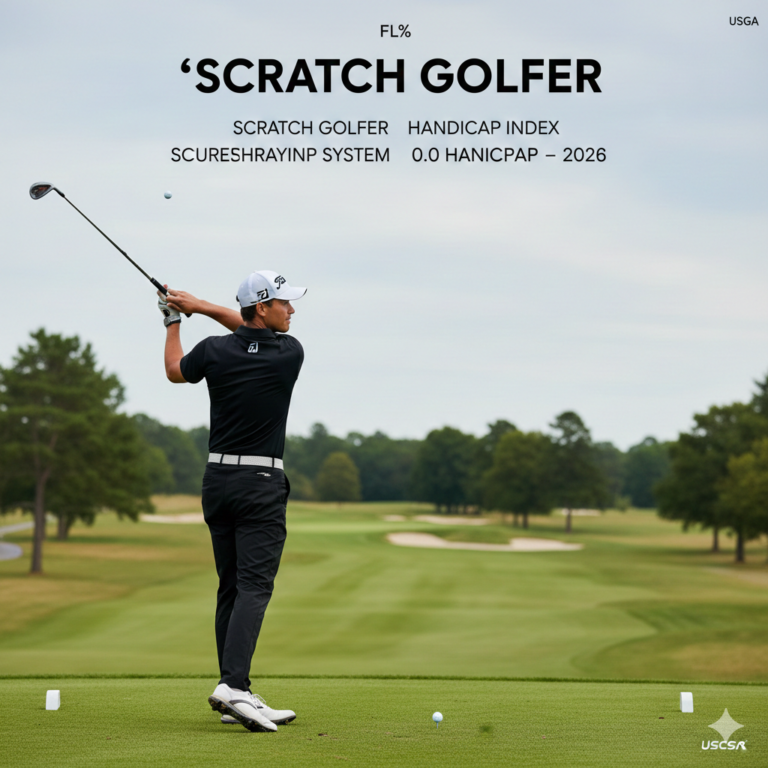
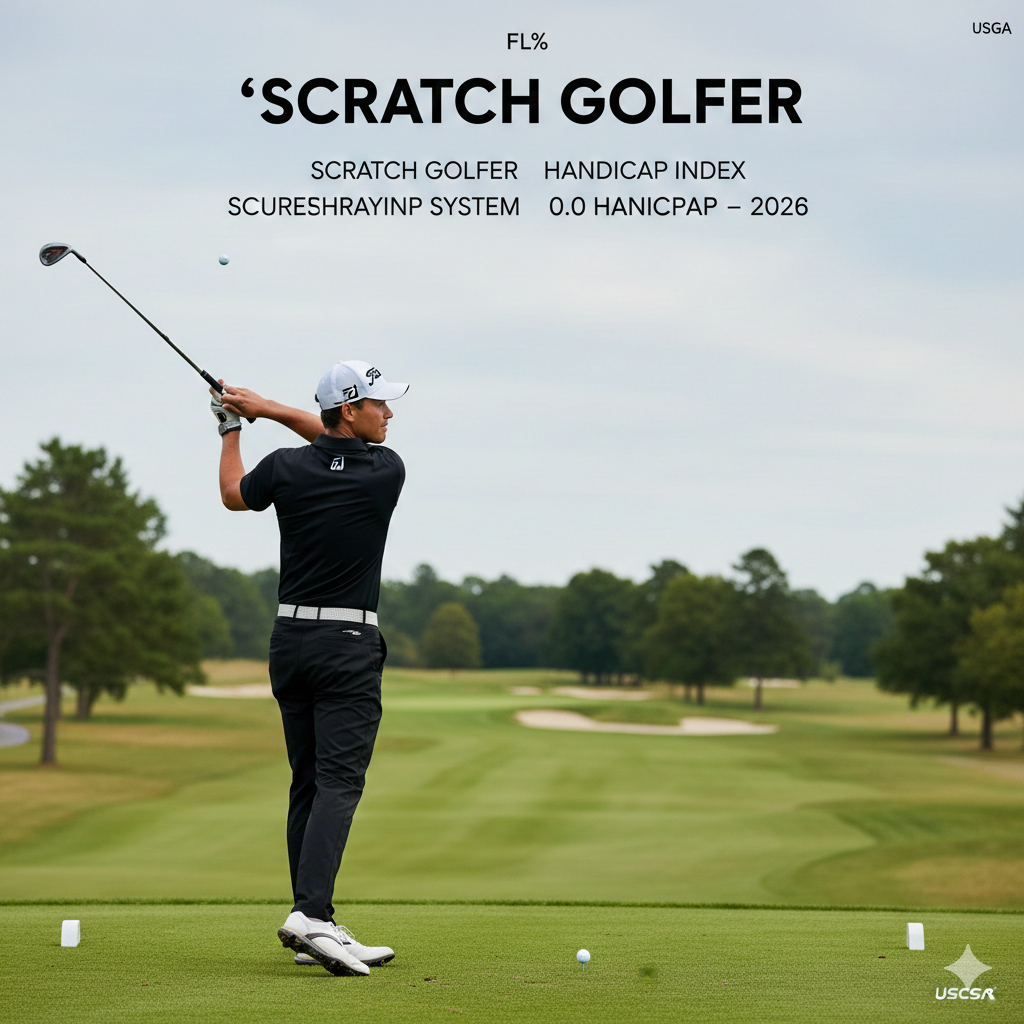
In the world of golf, the term “scratch” represents the pinnacle of amateur achievement. It is the “North Star” of the handicap system, serving as the benchmark for course difficulty and the standard against which every other golfer’s skill is measured. While many casual players assume a scratch golfer simply shoots par every time they tee it up, the reality is far more nuanced.
Becoming a scratch golfer requires a rare blend of physical precision, mathematical strategy, and elite psychological resilience. This guide explores the technical definitions, statistical benchmarks, and the rigorous training required to join the elite “1% Club” of the golfing world.
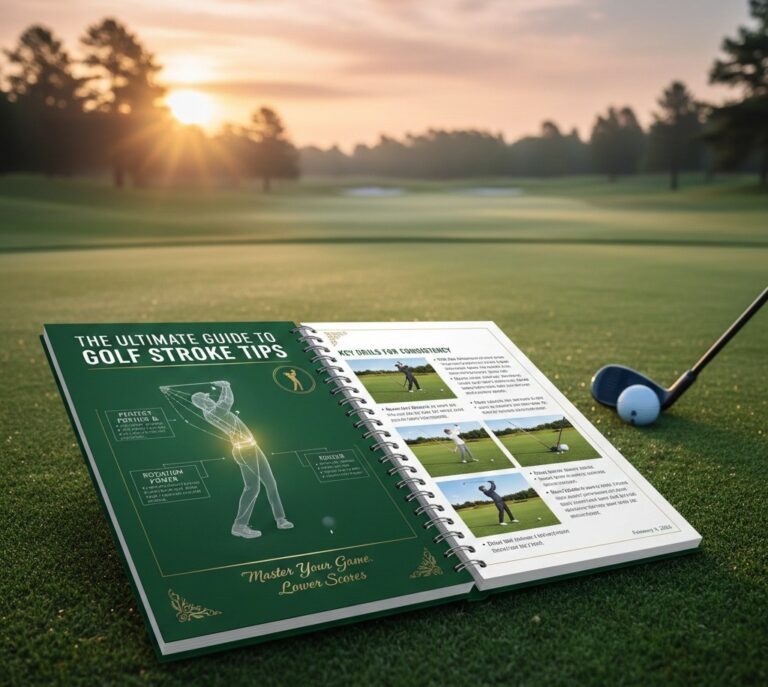
You Might Also Like: Golf Stroke Tips
Defining the Scratch Golfer: USGA and WHS Standards
The official definition of a scratch golfer is codified by the United States Golf Association (USGA) and the R&A under the World Handicap System (WHS). Technically, a scratch player is defined as a golfer with a Handicap Index of 0.0.
This designation implies that the player has the demonstrated ability to play to a Course Handicap of zero on any rated golf course under normal conditions. It is a measure of potential, not a scoring average. A scratch golfer is expected to play to their handicap—roughly shooting the Course Rating—approximately 20% to 25% of the time.
Physical Benchmarks for Course Rating
When USGA rating teams evaluate a course’s difficulty, they model the scratch golfer using specific physical parameters to determine “effective playing length”.
| Parameter | Male Scratch Golfer | Female Scratch Golfer |
| Average Drive Distance | 250 Yards | 210 Yards |
| Long-Hole Reachability | 470 Yards in 2 Shots | 400 Yards in 2 Shots |
| Landing Zone Evaluation | Evaluated at 250 Yards | Evaluated at 210 Yards |
Note: These are standard metrics for rating purposes at sea level; modern performance data often shows scratch players hitting it significantly further.
The Mathematics of Scratch Golf
The scratch golfer is the anchor for two primary metrics: Course Rating and Slope Rating.
Course Rating
The Course Rating indicates the difficulty of a golf course for a scratch player under normal conditions. If a course is rated 72.5, a scratch player is expected to shoot around 72 or 73 on their best days.
Slope Rating
The Slope Rating measures the relative difficulty of a course for a “bogey golfer” (typically a 20.0 index for men) compared to a scratch golfer. The formula for determining Slope Rating is a direct comparison of these two archetypes:
$$Slope Rating = (Bogey Rating – Course Rating) \times 5.381 \text{ (for men)}$$
$$Slope Rating = (Bogey Rating – Course Rating) \times 4.24 \text{ (for women)}$$
For the scratch golfer, the Slope Rating has a minimal impact on their Course Handicap because the differential between their 0.0 index and the 113 standard difficulty is zero.
The Score Differential
To maintain a 0.0 index, a golfer’s performance is tracked via Score Differentials:
$$Score Differential = (Adjusted Gross Score – Course Rating – PCC) \times \left(\frac{113}{Slope Rating}\right)$$
A scratch index is maintained by averaging the best 8 differentials out of the most recent 20 rounds.
Statistical Profile: Anatomy of a 0.0 Handicap
What does a scratch round actually look like? Data from providers like Arccos and Shot Scope reveals that scratch golfers are not “birdie machines,” but rather masters of avoiding disaster.
Performance Benchmarks (Scratch vs. 10 Handicap)
| Metric | Scratch Golfer (0.0) | 10 Handicap Golfer |
| Driver Distance (P-Avg) | 285 Yards | 259 Yards |
| Fairways Hit % | 50% – 60% | 48% |
| Greens in Regulation (GIR) | 59% | 32% |
| Up-and-Down % | 54% | 39% |
| Putts Per Round | 29.9 | 31.2 |
| Three-Putt % | 3% | 7% |
| Birdies Per Round | 2.34 | 0.72 |
The “Long Miss” and Ball Striking
One of the most revealing traits of scratch golfers is their putting behavior: they are the only handicap bracket that typically misses their putts long rather than short. This ensures they give the ball a chance to go in and allows them to see the break for the return putt, which contributes to their low 3% three-putt rate.
In terms of iron play, scratch golfers hit the green twice as often as a 10-handicapper. Their misses are also more manageable; from 150 yards in the fairway, a scratch player’s average proximity to the hole is approximately 37 to 41 feet.
Scratch Golfer vs. PGA Tour Professional: The Skill Chasm
A common misconception is that a scratch golfer is essentially a “pro.” In reality, the gap between a 0.0 index and a PGA Tour professional is massive—often wider than the gap between a scratch golfer and a mid-handicapper.
- Handicap Index: Most Tour pros would play to a handicap between +5.4 and +7.0.
- Scoring Gap: On average, a Tour professional is 5.5 strokes better than a scratch golfer per round.
- Course Difficulty: Pros play on courses rated 3.2 strokes more difficult and approximately 1,000 yards longer than typical amateur setups.
- Tiger Woods’ Peak: During his 2008 season, Tiger Woods’ average index was calculated at +8.8, peaking at +9.3.
Elite Strategy: Course Management Systems
Reaching scratch is rarely about a “perfect” swing; it is about smarter decision-making. Elite players often utilize advanced systems to eliminate emotions from the game.
The DECADE System
Developed by Scott Fawcett, the DECADE system (Distance, Expectation, Correct Target, Attack, Defense, Execute) uses PGA Tour scoring statistics and shot-distribution patterns to guide target selection.
- The Statistical Problem: Instead of “pin hunting,” scratch players aim for targets that keep their entire dispersion pattern out of penalty areas.
- Mental Fortitude: By using a pre-determined strategy, the player removes the emotional outcome of a single shot and focuses on the long-term process.
The “Six 3’s” Concept
A popular strategy for breaking into the scratch tier is aiming for six 3’s on the scorecard :
- Par 3s: Aim for the middle of the green to secure four pars (four 3’s).
- Short Par 4s: Choose a tee club that leaves a full “stock” yardage to attack the green safely for two birdies (two 3’s).
Training and Technical Discipline
Reaching 0.0 requires a shift from “block practice” (hitting the same club to the same target) to variable practice and pressure simulation.
Speed Training
Distance is a significant scoring engine. Scratch players often use tools like Rypstick, SuperSpeed, or The Stack System to increase clubhead speed.
- Frequency: 20–25 minutes, 2–3 times per week.
- Gains: Golfers can add 1–2 MPH of speed monthly, with every 1 MPH yielding 2–3 yards of distance.
Short Game Drills
- The Ladder Drill: Placing clubs a yard apart on the green to practice landing chips in specific gaps.
- The Penny/Dime Drill: Placing a coin three inches in front of the ball to ensure the “low point” of the swing is forward, resulting in “crispy” contact.
- Worst-Ball Drill: Hitting two balls and always playing from the worst position to train recovery skills.
Psychology: The “Beast Mind”
The mental game of a scratch golfer is characterized by emotional fortitude and the “Beast Mind”—a mentality where every decision is filtered through the question: “What would a scratch golfer do here?”.
A professional-level pre-shot routine is a mandatory anchor for this mentality. It typically includes:
- Assessment: Yardage, wind, and lie.
- Visualization: Seeing the trajectory and roll like a “movie” in the mind.
- Feel: Replicating the rhythm with a practice swing.
- Execution: Pulling the trigger within 5–10 seconds to avoid “paralysis by analysis”.
Global Demographics: Who are the Scratch Golfers?
Reaching scratch status is an achievement shared by less than 1% of the global golfing population. In the United States, roughly 1.6% of male golfers and 0.37% to 0.75% of female golfers with an official handicap have reached 0.0 or better.
| Gender | Handicap Carriers | % Scratch or Better |
| Men | ~3.1 Million | 1.99% |
| Women | ~300,000 | 0.75% |
| Overall | ~3.4 Million | 1.6% |
Safeguards: Exceptional Score Reductions
To ensure a Handicap Index accurately reflects a player’s ability, the WHS includes an Exceptional Score Reduction (ESR).
- 7.0 – 9.9 strokes below index: Triggers a -1.0 automatic reduction.
- 10.0+ strokes below index: Triggers a -2.0 automatic reduction.
This reduction is applied to the previous 20 differentials, ensuring a single brilliant round lowers the index appropriately.
Frequently Asked Questions (FAQ)
1. What is the official definition of a scratch golfer? A scratch player is a golfer with a USGA/WHS Handicap Index of 0.0.
2. Does a scratch golfer always shoot par? No. They are expected to play to their handicap (shoot par or the course rating) only 20% to 25% of the time. Their average score is typically 2–4 strokes over par.
3. What percentage of golfers are scratch? Fewer than 1% of the world’s 68 million golfers are scratch. Among those with official handicaps, about 1.6% are scratch or better.
4. How much better is a PGA Tour pro than a scratch golfer? A Tour pro is approximately 5.5 strokes better than a scratch golfer per round and plays on much longer, more difficult courses.
5. What is a “plus” handicap? A plus handicap (e.g., +2) belongs to a golfer who is better than scratch and must add strokes to their gross score in net competitions.
6. What is the average driving distance of a scratch golfer? For course rating purposes, the USGA uses 250 yards (men) and 210 yards (women), but real-world performance tracking shows many scratch golfers average 285 yards off the tee.
7. How many birdies does a scratch golfer make per round? A scratch golfer averages approximately 2.34 birdies per round, compared to 0.72 for a 10-handicapper.
8. Can a scratch golfer play in the U.S. Open? Any golfer with a Handicap Index of 1.4 or better is eligible to enter U.S. Open qualifiers, meaning scratch golfers can attempt to qualify.
9. What is the “Six 3’s” concept? It is a scoring strategy to record six scores of “3” in a round—typically by aiming for pars on par 3s and attacking short par 4s.
10. What is a typical GIR (Greens in Regulation) percentage for scratch? A scratch golfer hits the green in regulation about 58% to 60% of the time.
11. Do I need to be a scratch golfer to become a PGA Professional? No. To enter the PGA of America’s Professional Golf Management program, men need a 4.4 handicap or better and women need a 6.4 or better.
12. What is the DECADE system? It is a data-driven course management system developed by Scott Fawcett that helps golfers pick better targets based on statistical dispersion.
13. How many three-putts does a scratch golfer have? A scratch golfer averages about one three-putt every 39.2 holes, or roughly 3% of the time.
14. What is the “Beast Mind” in golf? It is a mental strategy focused on deliberate practice and maintaining a “champion mentality” by filtering all decisions through the eyes of an elite player.
15. What is the Exceptional Score Reduction (ESR)? It is an automatic WHS adjustment that reduces a player’s index if they post a score 7.0 or more strokes better than their current handicap.
Conclusion
The journey to becoming a scratch golfer is one of the most demanding and rewarding pursuits in sports. It is a milestone that marks the transition from playing “at” the game to truly mastering its complexities. By combining elite ball striking with data-driven strategy and a resilient mental routine, any dedicated player can begin the climb toward the 0.0 benchmark. Whether you reach scratch or simply improve your handicap, understanding the standards of elite amateur play provides the ultimate roadmap for golfing success.